Back to Insights
Measurement
The Reality Behind 'Perfect Attribution'
'Perfect attribution' has become an expensive distraction. A more realistic way to measure what actually drives growth.
May 27, 2026
Measurement
'Perfect attribution' has become an expensive distraction. A more realistic way to measure what actually drives growth.
May 27, 2026
Attribution is often treated as the backbone of paid media reporting. The assumption is simple: if every conversion can be traced back to a specific click or impression, marketers gain total clarity over performance. But the real question is whether that clarity reflects reality - and in practice, it rarely does.
The pursuit of ‘perfect attribution’ has become an expensive distraction from what actually matters: incremental, profitable business growth.
Today’s performance marketers operate in a fragmented ecosystem shaped by privacy restrictions, browser-level tracking limitations, consent loss, and consumer journeys that span across multiple devices and channels. In this environment, perfect attribution is no longer a realistic standard. That does not mean measurement is broken, nor does it mean budget allocation becomes guesswork… it simply means the measurement framework must evolve.
Instead of forcing fragmented platform data into a single “source of truth”, performance marketers should work with a hierarchy of signals: blended business performance, incrementality testing, platform trends, and attribution data used in context rather than in isolation.
The core challenge with modern attribution is that every advertising platform measures performance through its own attribution logic.
Meta, Google, TikTok, and GA4 all apply different attribution windows, modelling approaches, and conversion definitions when assigning credit for a sale. As a result, the same customer journey can produce completely different reporting outcomes depending on which platform you look at.
In some cases, multiple platforms may legitimately claim credit for the same conversion, while overall reported performance doesn’t match up with actual business results. This is not a tracking error - it is a structural outcome of how digital advertising measurement works today.
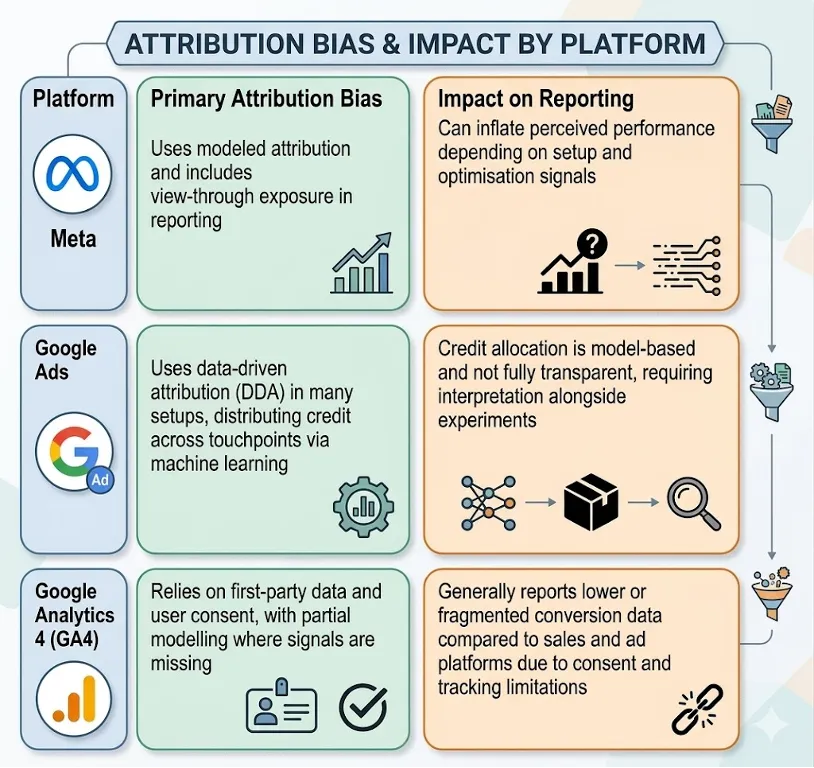
In practice, platform-reported conversions rarely exactly align with backend sales data due to differences in attribution windows, identity resolution, and consent coverage. This makes line-by-line reconciliation less useful than understanding directional trends and overall business impact.
At Kandidly, we believe the primary constraint in scaling brands is not a lack of data, but over-reliance on any single measurement lens. That said, attribution is not useless - it is simply not absolute.
The role of paid media is to drive profitable, incremental business growth, not to achieve statistical perfection in a software dashboard.
We advise our partners to stop asking, "Which specific ad gets the credit?" and start asking, "Is our entire marketing engine driving profitable top-line growth?". If you manage your budget based only on individual platform claims, you are effectively letting Mark Zuckerberg and Sundar Pichai dictate your business strategy.
To scale predictably, operators should move from rigid attribution models to a multi-signal framework that prioritises commercial reality over isolated platform metrics.
This approach typically relies on four layers of insight:
Instead of evaluating channels in isolation, look at the macroeconomic health of the business.
Monitor Marketing Efficiency Ratio (MER) - calculated as total revenue divided by total ad spend - alongside blended Customer Acquisition Cost (CAC). These macro metrics serve as the ultimate guardrails for profitability. If your platform ROAS is climbing but your blended MER is dropping, your marketing is becoming less efficient, regardless of what the Meta dashboard claims.
Shift your focus from absolute numbers to directional trends. Look for correlations over 14-day and 30-day windows. For instance, when Meta spend scales up, does organic search volume or direct traffic spike three days later? This directional trend reveals the true halo effect of your paid media spend, capturing the additional value that direct tracking pixels miss entirely.
The only definitive way to understand a channel’s true impact is through incrementality testing. This involves executing intentional budget shifts or geographic holdout tests. By pausing or significantly dropping spend in a specific region or campaign type for a set period of time, you can measure the exact impact on total baseline revenue. If total revenue drops proportionally, the channel is incremental. If revenue remains flat, you have identified wasted spend that may have been merely capturing existing demand.
Attribution still has value, but only as a diagnostic layer, not a decision engine.
It helps answer questions like:
Used properly, attribution explains behavior. It does not, however, define truth.
The brands that will dominate the next decade are those that accept a certain level of data ambiguity as an unavoidable business reality. By shifting focus from isolated platform pixels to blended business health, founders gain the confidence to fund aggressive growth without being blinded by fragmented data.
Growth is found in the patterns, not the pixels.
Valentina Di Maria
Account Manager
A Sicilian who grew up in Venice, Valentina made the questionable decision to swap the city of canals for the city of rain a few years back and, having cut her teeth in more generalist marketing (studying and working) has joined us to specialise. Loves walking (not running!) in nature, good coffee and despite her seemingly sweet and demure attitude, boxing!
View all articles →Tagged
More reading
We help ambitious ecommerce and DTC brands grow through paid media that actually performs.
Let's talk