Back to Insights
Meta Ads
Meta's Click Attribution Update
Meta now requires a verified link click for click-through attribution. Why your dashboards look worse, and why that's a good thing.
June 10, 2026
Meta Ads
Meta now requires a verified link click for click-through attribution. Why your dashboards look worse, and why that's a good thing.
June 10, 2026
The digital advertising industry has long operated under a flexible definition of intent, allowing Meta to aggregate a broad spectrum of user actions into its click-through reporting columns.
For years, actions such as likes, sharing a post, saving a video were all tracked under clicks and accounted for under “click attribution” methods. If a purchase occurred within seven days of any of these minor interactions, Meta claimed the conversion as a click-through success.
This system created a persistent discrepancy between Meta Ads Manager and third-party analytical tools, which eroded the confidence of media buyers and muddied commercial models for DTC founders.
On March 3, 2026, Meta executed a structural realignment that forces brands to confront the raw reality of their direct-response mechanics.
Click-through attribution now strictly requires a verified link click, which effectively ends the era of social engagement metrics propping up click-attribution where likes and saves inflated performance metrics.
If your dashboards appear to have deteriorated since February, it is likely that your media is performing exactly as it always has, but you have simply lost the data cushion that social interactions previously provided.
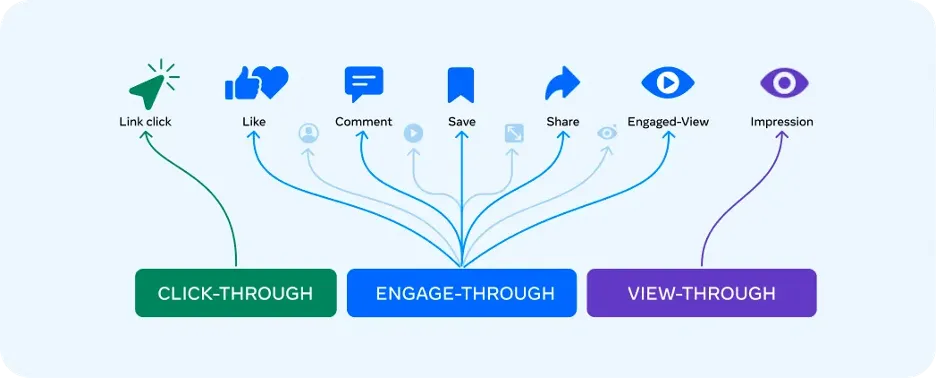
Source: https://www.facebook.com/business/news/click-attribution
The primary function of this update is the aggressive narrowing of the click-through definition.
Going forward, click-through attribution exclusively counts high-intent actions that propel a user toward a conversion destination.
These actions include clicks on website links, app store redirects, or Meta Shop interactions.
While the definition includes specific media interactions like launching a watch and browse experience, the fundamental shift is the total removal of likes, shares, and comments from the primary attribution criteria.
To accommodate the massive volume of interactions stripped from the click-through category, Meta has introduced a newly established category named engage-through attribution. This framework captures all non-link social engagements and assigns them a strict one-day attribution window. Consequently, if a user saves an advertisement and completes a conversion within twenty-four hours, the conversion is logged in the engage-through column rather than being counted as a direct click-through.
The restructure also fundamentally alters video tracking by reducing the threshold for a meaningful video view from ten seconds down to five.
This decision is anchored in platform consumption data which indicates that 46 percent of Reels-driven purchase conversions occur within the first two seconds of user attention.
Because the system now utilizes a one-day window for these engagement signals, securing the first few seconds of attention has become a structural requirement for reporting survival.
| Feature | Legacy Model (Pre-March 2026) | Updated Model (Post-March 2026) |
|---|---|---|
| Click-Through Definition | Included link clicks, likes, shares, saves, and comments | Strictly limited to verified link clicks |
| Engagement Tracking | Engaged-view attribution (video only) | Engage-through attribution (all formats) |
| Video Threshold | 10 seconds of continuous watch time | 5 seconds of continuous watch time |
| Attribution Windows | 7-day click window for all aggregated interactions | 7-day window for link clicks; 1-day window for social/video |
In our opinion, this update is a necessary correction to a measurement problem that has existed for far too long.
Meta’s in-platform reporting has historically been heavily inflated by generous attribution windows. Many veteran operators will remember the era of 28-day click attribution, which often took credit for sales that would have happened organically.
At Kandidly, we have always worked to reduce this reporting inflation by focusing on attribution setups that prioritize the most likely incremental sales visible in the financial back-end.
This update reinforces the exact structures we already implement in our clients' ad accounts. By stripping away assisted social padding, the platform is finally forcing a focus on the most likely incremental conversions driven by Meta, particularly in prospecting campaigns.
We view this not as a loss of data, but as a gain in clarity that allows us to scale based on genuine commercial impact rather than platform-specific optical illusions.
The immediate consequence of this shift is an undeniable contraction in reported click-through conversions, but this represents a reclassification of data rather than a deterioration of actual performance.
Any conversion stemming from a non-link interaction that materializes between day two and day seven will now drop out of primary reporting columns entirely, even though the revenue still hits your Shopify dashboard.
Jack Ellis
Head of Paid Media
An Essex boy (wayhey), Jack recently moved to South London with his partner and their pup. Nicknamed 'Mr Process' in previous roles, he brings 6+ years of agency-side experience in both digital and ATL. A down-to-earth guy, he'd admit he's basically working to fund his love of food & travel; when not planning his next adventure, he's likely to be found doing something sporty, with a passion for the gym, running, cycling and a bit of hiking.
View all articles →Tagged
More reading
We help ambitious ecommerce and DTC brands grow through paid media that actually performs.
Let's talk