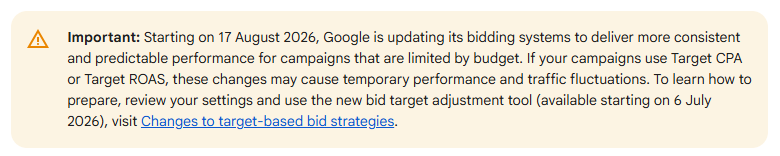
You may’ve already seen the above, but if not – this blog’s for you. On 17th August, Google is changing the way target-based bidding behaves when campaigns are constrained by budget. (No, this won’t affect max conversions, max conversion value or any other bid strategy that doesn’t have a target on it!).
For advertisers using Target CPA or Target ROAS, the important point is not that Google will change the targets themselves. It’s changing how closely its systems will work towards those targets as budgets increase.
That matters because some campaigns are currently doing better than the target they’re set to aim for.
A campaign with a £50 Target CPA, for example, might be generating conversions at £30 while regularly hitting its budget limit. That gap can look like a straightforward win. From 17th August, however, advertisers should expect budget-constrained campaigns to work more consistently towards the target they have actually entered. Yep, that means performance may actually decrease!
The reasoning, according to Google, is to make scaling more predictable. So an increase in budget may lead to a more obvious change in CPA, ROAS or conversion volume.
What’s actually changing?
At the mo, a campaign limited by budget can sometimes – or consistently – outperform its tCPA or tROAS by a considerable margin.
Imagine a Shopping campaign with a £200 daily budget and a 5x Target ROAS. If it’s got a lot of profitable demand available within that budget, Google may drive an 8x or 10x ROAS. That doesn’t necessarily mean the campaign could maintain a 10x ROAS at a much higher level of spend. Up until now, the system has been finding the most efficient opportunities available within the constraint.
The problem appears when the budget is increased.
Historically, increasing the budget could result in the campaign moving away from that unusually strong level of efficiency and towards the target that was originally specified. The change could be tricky to forecast, particularly when budgets were being increased in stages.
From 17th August, Google says target-based bidding will behave more consistently towards the advertiser’s stated target as budgets change. The intention is that a campaign can be scaled without the same degree of volatility in efficiency. Which is actually pretty useful, as long as you’re happy with the target.
However, if you’re not keeping a close eye on targets and adjusting them regularly, and instead allowing campaigns to outperform legacy targets – this may produce changes you’re not happy with.
The target in your account will be more important going forwards
This is the part worth paying attention to.
Suppose a campaign has:
- Target ROAS: 500%
- Actual ROAS: 900%
- Budget: £500 per day
- Status: Limited by budget
If you increase the budget without changing anything else, the campaign may no longer deliver the 900% ROAS you’ve gotten used to. Under the new system, the 500% target becomes a much clearer indication of the efficiency Google is being asked to pursue. To be clear, this doesn’t mean Google will suddenly force the campaign to produce exactly 500% or treat it as a super strict upper limit.
It does mean that any advertisers who’ve been doing so should stop treating the target in the interface as a set and forget. It’s now the main setting that’ll determine your performance.
So before changing budgets, you’ll need to check the target is still what you’re after.
So what should you be looking at?
This update doesn’t mean you need to check every single campaign in your account, every time you make a budget change, however minimal.
The campaigns most worth reviewing are those that combine three characteristics:
- They use tCPA or tROAS bid strategies
- They are regularly limited by budget
- Their actual performance is slightly or significantly above target
For each campaign, compare the target with recent actual performance. A 30 to 60-day view is a useful starting point, but the right period depends on conversion volume, seasonality and how quickly the business normally responds to changes.
Change the target before increasing the budget
If the evidence supports a higher efficiency target, change that first – and then increase the budget.
Doing it in the opposite order creates an unnecessary period in which Google is being given more budget while still being instructed to optimise towards a target that may be considerably less demanding than the performance you actually want.
Google has introduced a Bid Target Adjustment Tool to help advertisers identify affected campaigns and review their targets ahead of the change.
Therefore, these are the steps to follow:
Find the campaigns.
Identify target-based campaigns that are budget-constrained.
Check the numbers.
Compare the current tCPA or tROAS with recent actual performance.
Decide what efficiency is commercially acceptable.
Don’t just whack in the highest number from the last few weeks! Consider margin, customer value, seasonality and the level of spend you want the campaign to support.
Update the target where appropriate.
Then review the budget.
If there is additional profitable demand, give the campaign room to capture it.
This is a better approach than treating 17th August as a date on which every target needs to be changed.
Cross channel campaigns deserves a closer look
Performance Max and Demand Gen are particularly interesting because they operate across multiple Google inventory types.
Google says the new approach should make budget changes more predictable, including reducing some of the unexpected changes in how spend is allocated across channels. (We’ve all seen YouTube start serving, stop serving, start serving, and then stop serving again – an extremely annoying recent quirk!).
More stable bidding behaviour doesn’t however mean that channel allocation will become fixed or completely transparent. Performance Max remains a system where Google decides how to distribute spend based on its assessment of available opportunities; that’s not going to change.
For that reason, it is useful to record the current performance before making changes.
Look at:
- Spend
- Conversion value
- ROAS
- CPA where relevant
- Search versus non-Search contribution where available
- Asset-group performance
- NCA performance if relevant
That gives you something to compare against once the new bidding behaviour is in place.
Don’t confuse a platform target with a business target
There is a broader issue underneath this change.
A Target ROAS of 600% may be perfectly reasonable from an account-management perspective and still be the wrong target for the business.
ROAS doesn’t tell you:
- whether customers are new or returning
- whether the products sold have healthy margins
- whether revenue will repeat
- whether customer acquisition costs are sustainable
- whether the campaign is helping a strategic growth objective
The same applies to Target CPA.
A £40 CPA can look excellent until you discover that the customers acquired at that cost have materially lower lifetime value than the customers acquired elsewhere.
As more campaign decisions are handed to Google’s automated bidding systems, the quality of the signal being supplied to them becomes increasingly important.
If the business cares about NCA, feed that objective into the account. If profit matters more than revenue, make sure value signals reflect that. If offline sales or later-stage revenue are important, make sure those signals can reach the bidding system.
A highly automated campaign can only optimise towards the information it receives.
Who should be paying closest attention?
This change matters most to advertisers who regularly move budgets around.
Ecom brands who have peak trading periods are an obvious example; big holidays, promotions and paydays, to name but a few.
The same applies to businesses with strict acquisition targets, SaaS companies managing pipeline, financial services businesses working within tight CAC limits, and brands that deliberately increase media investment around launches or seasonal events.
If budgets stay broadly flat and campaigns aren’t constrained, the change is less likely to create a dramatic before-and-after moment. However, if you’re raising budget from £500 to £1000 – it’s absolutely key to pay attention to your target.
A sensible account review before 17 August
Start with campaigns marked as Limited by budget. From there, isolate those using Target CPA or Target ROAS and compare their targets with recent performance.
For campaigns that are significantly outperforming their targets, decide whether that level of efficiency is realistic and commercially desirable at a higher level of spend.
If it is, adjust the target before increasing the budget.
For Performance Max and Demand Gen, record the current performance and available channel-level information so that changes after 17th August can be assessed properly.
A campaign moving from 900% ROAS to 600% ROAS is not necessarily a failure if the campaign is now spending considerably more and generating substantially more profit. Looking only at the headline ROAS can make a successful scaling exercise look like a mistake.
The useful comparison is between efficiency, volume and the actual commercial outcome.
The deadline is 17 August. The decision is yours
Google’s change is designed to make target-based bidding behave more predictably when budgets change. That is a reasonable objective.
But predictability does not make an arbitrary target a good target.
For advertisers with budget-constrained campaigns that are consistently outperforming their stated CPA or ROAS goal, the next few days are a good opportunity to check whether the number in the account still reflects the business’s ambitions.
The key sequence is simple: identify the campaigns, look at what they are actually achieving, decide what performance is worth protecting, then make budget changes.
So in this case, it’s the campaigns that are over-delivering that need prioritising – not the ones that are struggling.